The Affirmative [is] one of the most controversial issues that has been dragging in the Brazilian Congress for most of the first decade of the century, was excluded from the Race Equality Statute adopted on 16 June by the Senate. The policy, which would implement a temporary quota system mandatory for Afro-Brazilian universities, jobs and political parties, was rejected along with incentive measures for private companies to adopt the system [pt]. According
groups in favor of affirmative action, the policy decision to exclude disregards the historical processes that led to the state of social and racial inequality exists in Brazil today. On the other side of the coin are the opponents of affirmative action that talk about reverse discrimination and inciting racial tensions.
The day before the vote in Congress, the blog Race No [pt], who presents himself as anti-racist and anti-racial policies public, published the justification of Senator Demosthenes Torres opposition to affirmative action. The Senator, a member of DEM [pt] (Democratic) opposition party the PT [es] President Lula says that race does not exist and justifies why the text removed - but not the title "Race Equality Statute" - the terms "race", "racial" and "ethno-racial."
The human genome is composed of 20 000 genes. The apparent differences (hair color, hair texture, nose shape) are determined by a set of genes negligibly small compared with all human genes.
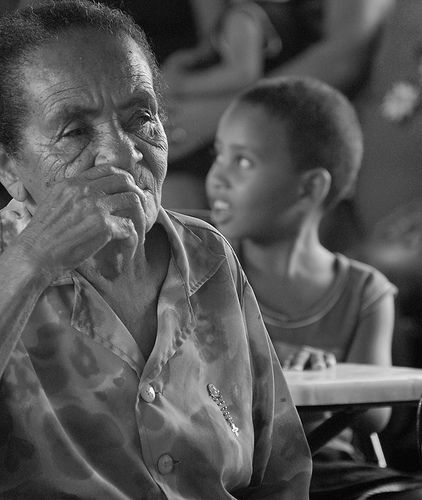
Quilombola, Flickr, Gallery of Gabriela Amorim,
CC LicenseSuch opinions do not take into account the political and historical processes that once used race and scientific racism as an argument for exploitation and colonization [ing]. In fact, it happens that the problem has more de 7 años y es más grande que el congreso. El blog Controvérsia [pt] cuenta una historia alternativa al final feliz que la abolición a menudo representa en las mentes de los brasileños y describe cómo la lucha afro-brasileña por la integración y las guerras de reparación fueron mucho más fuertes que lo que se piensa generalmente.
El final del siglo XIX y el inicio del XX estuvieron marcados por una batalla por la memoria de las luchas populares abolicionistas y por las demandas de integración y ciudadanía. En varias regiones del país surgieron asociaciones, entidades y clubes formados por esclavos liberados y por la población negra en general, pertenecientes both literary sectors as well as media and entertainment operators. The main demand was to meet to discuss organizational matters of interest to the "men of color" or "color classes." At that time, there was a proper political volcabulario blacks, by which to assess their integration into society, their demands, their behavior, their strategies, ways of acting and their complaints and protests against the social order.
In Blog da Preta Jaqueline Santos Lima [pt] also expresses his anger at the abandonment of the historic responsibility to respond to the old claims of Brazilians Black :
The deal that allowed the adoption of the Statute (which will be used as a flag in the electoral process by both the PT as the DEM), simply buried the black people's historical claims, once the excluded text adopted quotas for blacks in the universities, at parties and in public services, excluded the right to security of land tenure quilombolas; excluded the defense and the right to freedom of religious practice with African and non- referred to the need for care of the State of genocide committed by the police that victimizes black youth.

Canhotagem Gallery, Flickr, CC license
Motion Black Swan [pt], the government's refusal to grant the right of land reclaimed from the people of Quilombola is mitigated by the recognition that state Quilombola communities should have a differential treatment by the authority. For them there are positive points in the statute that must be defended, among them the implementation of black history in early childhood education and recognition of the contribution of black Brazilians.
The main merit of the Race Equality Statute is definitely down the myth of racial democracy in Brazil's institutions and begin construction in practice. Through it, the State recognizes that social inequality weighs negatively on black people, recognizes that racism is a constructor element of inequality and recognizes the need to implement public policies to overcome social inequalities, educational, economic, within the Brazilian people. In a country which has always denied its imperfections, refused to change, naturalized the social gulf that separates rich and poor, black and white, a law establishing the rescue rights shows a great evolution of civilization.
Other, self-positioned against affirmative action, believe the problem is being based on racial criteria, rather than social conditions. This is the case Vandel Ferreira [pt], blogger and lawyer in Rio de Janeiro:
Pardon those who advocate the so-called "affirmative action policies" on racial issues, to my view, have nothing in the affirmative; precisely because it hurts equal treatment under the constitution. Again, the quotas in public universities should be given according to the condition social benefit of the underprivileged. In addition, we have to look for is the access to education at any level, even post-college for all, without exception, free and universal. For the huge Brazilian tax burden, would be the minimum refund of state citizenship.
The Statute without points claimed must still be approved by President Lula. But even if sanctioned, Afro-Brazilian movements promise to continue their fight now, finally, historical grievances have been officially recognized.


0 comments:
Post a Comment